
Australia Essentials
What should you definitely know about? What phone provider should you choose? E-sim or not? Apps you absolutely can't live without! Find out below, this and more!
OCEANIAAUSTRALIA
5/8/20247 min read
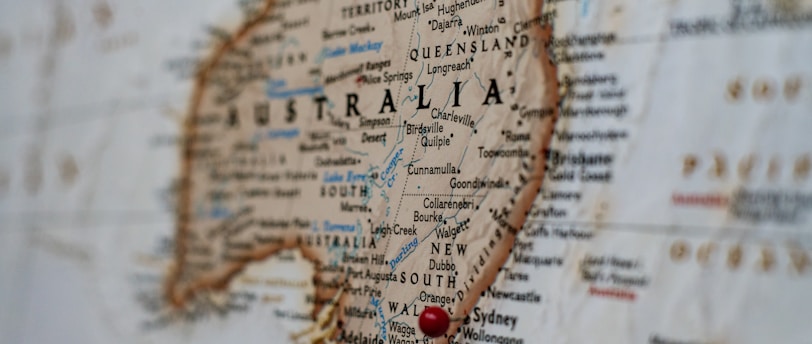

While googling before your trip, you'll find lots of information on what to bring, buy upfront and prepare. Here we'll break down what was actually helpful for us and why - hopefully these tips will help you as well!
Skip straight to:
Which phone provider?
There are many (international) companies nowadays that offer possibilities for E-sims with seemingly good discounts and deals. So is it ever better better to look into local companies/providers?

When you buy an E-sim from an international provider a key piece of information is missing: which physical network will you join when you land? In Australia, that will be a very big factor in determining how much coverage you actually get since a lot of the country has little service. So let's look at the options if you look at local providers:
Telstra : Has the largest network in the whole of Australia, so that will guarantee you best service (although it is also the most expensive); offers both physical and E-sims
Optus: The largest competitor of Telstra, is normally a bit cheaper and with interesting deals but it seems to have less coverage over the whole country
Telsim: Uses 85% of the Telstra network, but has a much cheaper price; also offers both physical and E-sims and international calls to 15 countries
You are only able to buy it when you arrive in Australia as the app store will not let you get the apps at a different location (perhaps this could be bypassed with a VPN but we didn't do it) - In any case, this is not an issue because all the airports have free WiFi.
It is likely that you will be able to get some kind of promotion to get more data or more calling minutes at any given time as they want to get new customers + don't think you will not need an Australian phone number. Having the possibility to make a phone call was quite useful to book a lot of camping grounds which either didn't have a website or the booking was difficult online as well as when booking experiences.
Telsim was the one we used (a little bit by accident because we thought it was part of Telstra) but it worked out well for us. We didn't have service 100% of the time, but we prepared well when we knew we would be on the road for a while in less traveled areas (i.e. downloading the maps, saving a few possible locations where we would like to sleep and some gas station locations). We never stayed very long periods in remote areas, so there might be worth it to go for Telstra, if you want to be on the safe side. But it is very likely that you will end up in a situation where you don't have service at some point, given the low population density.
International E-sim vs Local company E-sim (or physical)
The choice for E-sim vs physical is more dependent on your specific situation: if your phone has a dual-sim slot which you are not using, there is not much need for an E-sim, especially if you have a phone who is not yet compatible with E-sims. If you don't have a dual-sim slot and your phone is compatible with E-sims (check here), then this might be more convenient. But for the rest, they work exactly the same way and will both have a separate phone number.
In our research before traveling, we found that with the deals we could get in Australia from the different companies, it would be cheaper/better value for money to choose a local company than with the most famous providers (Holafly, Airlaro, etc.) and we could more easily tailor it to our needs at that time.
Which apps are useful?
There are many travel apps out there that can great benefits to your trip but few apps are the ones that you can consider really essential. For us, that was "Wikicamps Australia".
Never before had I actually paid to download an app, so that should tell a lot already. For the first few days, we were spending SO much time online trying to find the best places to camp (hopefully for free) and it was not going great... Until we got this recommendation from a friend and it was a game-changer! There are probably other apps you can try that are similar to this but do get one!
With this app you can check all possible spots people have added to the map near all over Australia, you can download it and keep it offline for when you're not having service and there are lots of reviews which help you understand whether a spot is worth the stop (or not). This helped us immensely and we can't recommend it enough!
Another app that is still worth mentioning, though not as essential, is "PolarSteps". With this app you can track your journey and add your "steps". Each step is a post where you can add photos, videos, places you have been as well as some text. People who follow you can see and comment. You can keep your account public or private and share it with who you like - this was a great way to keep our families in the loop and not worry about sharing pictures across all the group apps with friends. Plus, we have a really cool memory of our trip and you can even make a book from it at the end!
Not really an app but more of a website that we checked often: the websites for local emergency warnings! When you're traveling, it's easy to be out of the loop of what is going on in terms of news but in Australia, when you're traveling on your own for a long time, it's good to keep checking especially for fires. Per state they have a different website that we would visit every now and then to help us plan our routes more safely:
https://www.emergency.wa.gov.au/ (for Western Australia)
https://alert.tas.gov.au/?view=both (for Tasmania)
https://www.cfs.sa.gov.au/warnings-restrictions/warnings/incidents-warnings/ (for South Australia)
https://www.rfs.nsw.gov.au/fire-information/fires-near-me (for New South Wales)
https://emergency.vic.gov.au/respond/ (for Victoria)
https://www.fire.qld.gov.au/Current-Incidents (for Queensland)
https://www.pfes.nt.gov.au/incidentmap (for Northern Territory)
Best kept secret: Visitor centers
We call it a best kept secret because honestly we didn't see it mentioned online during our searches or heard about it from anyone we knew, but probably if you have been traveling for a while or are a local, this is a no-brainer to you. This is a great "tool" you available to yourself, especially if you don't want to spend too much time planning and keep things open!


Maybe in other countries this is common and we are just completely unaware but, in Australia, almost any town you visit will have information/visitor's center!
These were great to get an overview of what to do in the area, get some flyers with local hiking information or other specific activities happening, local camping sites and maps where the workers would detail out all we needed to know! We would very often find here information that we would not have encountered online that easily, with the added bonus of being a nice way to have a chat with the locals. All of it for free! With this, we didn't have to worry too much about planning things perfectly or deciding exactly how much time we wanted to spend where, before arriving.
They do close early, so it's best to get there in the morning (definitely before 17h) if you are planning to make use of it.
Wildlife you'd not expect to worry about!
Australia is famous for all the incredible wildlife encounters you may have - some you're looking forward to (hello rooos 🦘), other you may be dreading (🐍🕷️). But nobody prepared us for this! Who would have thought that the thing we would have most challenges with would be none other than: flies 🪰
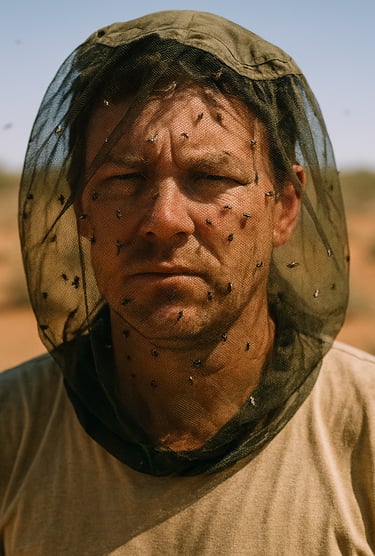
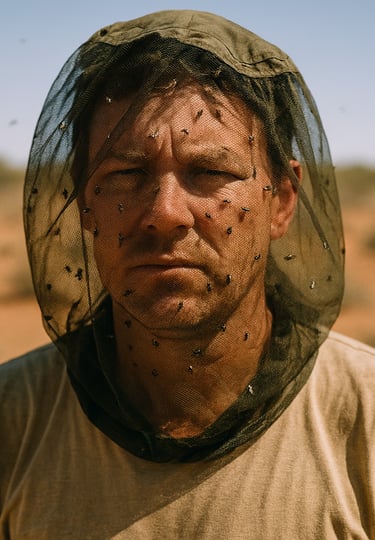
In case you're like us and thought the 'Australian wave' was connected to the vibrant surf scene but it turns out it refers to the hand gesture Australians often do when trying to keep away the flies from their faces - it's funny because it almost seems like you're waving at someone across from you but in reality, it's just about being able to keep going without this annoying pestilence.
But you probably thought you have experienced annoyance from flies in the past - I thought so to - but this was just a whole other level. For a couple of days, they would just be everywhere we were regardless of activity (wind or no wind). I'm not sure if it's related with the drought-like climate of the summer but they were thriving for any surface that was slightly moist - open skin area (even if not particularly sweaty), ears, nose, mouth and even the eyes. And worst of all, they actually would bite if you would not shoo them quick enough.
Therefore, we had essentially two options: cover up and get a face net (bug repellent absolutely did not work, even with DEET). This happened to us only in the south of Western Australia but we know this is common in the Outback and probably other places where it gets quite hot. It put a little bit of a bump on our experience because it really seemed difficult to handle and enjoy the hikes and beaches we were visiting so we wished we would have prepared more for this - be aware and manage your expectations!
Endless Summer
Travel insights for your next adventure await.
Connect
Discover
© 2025. All rights reserved.
Send us your feedback and suggestions!